[email protected] +91 772-2987-077
Foreseeable accidents

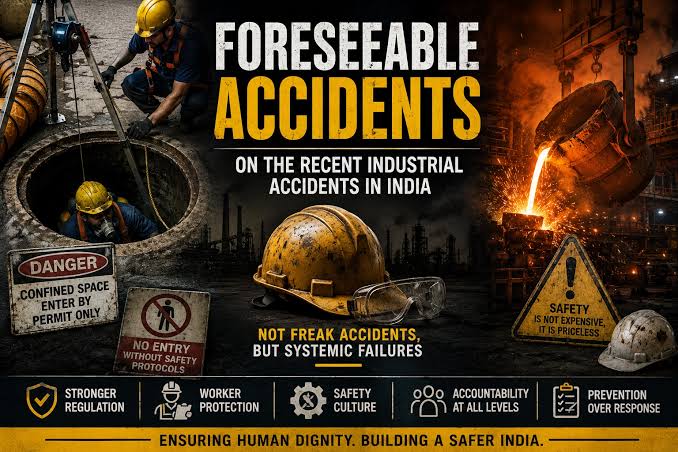
Foreseeable accidents: On the recent industrial accidents in India. 

Industrial mishaps are due to accumulated organisational weaknesses. 

Despite there having been a streak of industrial accidents in India of late, the notion that they are isolated and incidental persists. Within days of each other, four workers were killed in a ‘mishap’ in a septic tank in Surat while nine workers were killed by an explosion at a steel plant in Visakhapatnam. They appear to be different circumstances: one involved workers entering a confined space and succumbing to toxic gases; the other involved 150 tonnes of molten steel and a violent blast. Yet, industry has known of these risks and had developed preventive measures decades ago. In the Surat incident, four workers entered the tank and were overcome by toxic fumes. The circumstances resemble a well-known pattern in fatalities in confined spaces, where the first victims are often followed by would-be rescuers who enter without protection. There have been deaths in similar circumstances in Surat’s industrial sector in recent years. The working area must be mechanically ventilated and have rescue personnel on standby while the workers must have breathing apparatuses, harnesses and retrieval lines, and clear lines of communication. Unprotected entry must be strictly prohibited. Septic tank deaths and deaths due to manual scavenging are in fact rarely accidents in the sense of unforeseeable events, but failures of basic safety management, and the recurrence of such incidents speaks to the persistence of that failure. Likewise, while steelmaking is intrinsically more dangerous because it combines extreme temperatures, pressurised gases, heavy equipment, and enormous stores of heat energy, industry still knows the hazards it poses, and further that even relatively small process failures can result in multiple casualties

Both incidents, and the patterns they extend, are reminders of persistent safety failures in many parts of Indian industry. In Visakhapatnam, trade unions and former employees have alleged that the plant had reduced staffing, heavier workloads, ageing equipment, deferred maintenance, and an increasing dependence on contractual labour. Some also linked these trends to the difficulties the plant faced following the Centre’s divestment plans and the resulting constraints on investments. However true any of these factors are, they confirm that a major industrial accident is almost always due to the accumulation of organisational weaknesses. In fact, contract labour is central to understanding both incidents. Occupational safety research has consistently found that contracted workers face higher risks because they may receive less training and operate within systems with fragmented accountability. The incidents have also occurred during the gradual and uneven implementation of India’s new occupational safety framework — and highlight the invisible fact that the country’s industries remain anchored by old problems of manpower shortage, caste- and class-based exposure to hazardous labour, and a ‘cost over safety’ mindset in financially stressed units.

-

Foreseeable (adjective) - predictable, anticipated, expected, likely, calculable.

पूर्वानुमान योग्य

-
Mishap
(noun) – trouble, problem, difficulty, issue, setback दुर्घटना

-
Accumulate
(verb) – gather, amass, collect, pile up

जमा होना

-

Streak (noun) – run, spell, sequence, stretch, series

सिलसिला

-
Of
late (phrase) – Lately, recently,

हाल ही में

-
Notion
(noun) – idea, impression, thought, concept, opinion

धारणा

-

Isolated (adjective) – Separate, detached, solitary, segregated, aloof

अलग-थलग

-
Persist (verb) – Continue, endure, remain, maintain, persevere
बने रहना


-

Septic tank (noun) - underground tank for sewage treatment.

सेप्टिक टैंक

-

Explosion (noun) – Blast, detonation, eruption, burst

विस्फोट


-

Confined (adjective) – Restricted, limited, constrained, curbed, restrained, 

सीमित

-

Succumb (to) (verb) - to die from the effect of a disease or injury.

शिकार होना

-

Toxic (adjective) – Poisonous, noxious, harmful, dangerous, lethal

विषैला

-

Molten (adjective) - liquefied, melted, fluid, fused, hot.

पिघला हुआ

-

Blast (noun) - explosion, bang, gust, blow, eruption.

धमाका

-
Decade
(noun) – A period of 10 years

दशक

-

Fume (noun) – Smoke, vapor, gas, exhaust, emission

धुआँ

-
Resemble (verb) – Look like, mirror, imitate, be similar to, match
समान होना


-
Fatality
(noun) – casualty, death, mortality, victim, lethality

मृत्यु

-

. Rescuer (noun) - savior, liberator, helper, lifesaver, protector.

बचावकर्ता

-

Ventilate (verb) - air, aerate, refresh, circulate, breathe.

हवादार बनाना

-

Standby (noun) - ready, reserve, backup, alert, standby.

तैयारी की स्थिति

-

Apparatus (noun) – Equipment, device, machinery, system
उपकरण

-

Harness (noun) - belt, strap, fastening, tether, support.

हार्नेस (सुरक्षा बेल्ट)

-

Retrieval (noun) - recovery, reclamation, rescue, restoration, salvage.

पुनर्प्राप्ति या वापस लाना

-

Prohibit (verb) - ban, forbid, disallow, restrict, veto.

मना करना

-
Scavenging
(noun) – the act of searching for things among discarded material

सफाई

-

Persistence (noun) – Continuation, endurance, constancy, perpetuation, durability.

दृढ़ता

-

Likewise (adverb) – Similarly, In the same way, Equally, In like manner, Correspondingly

इसी प्रकार

-

Intrinsically (adverb) - essentially, fundamentally, naturally, innately, inherently.

आंतरिक रूप से

-
Enormous
(adjective) – huge, vast, extensive, expansive, broad, wide

विशाल, बहुत बड़ा,भारी

-
Hazard
(noun) – Risk, danger, peril, threat

खतरा

-
Pose
(verb) – constitute, present, create, cause, produce, give rise to,

खड़ा करना (चुनौती)

-
Result in
(phrasal verb) – To be the cause of: परिणाम होना

-
Causality (noun) – a serious or fatal accident

हताहत

-

Reminder (noun) - prompt, memory aid, cue, signal, token.

याद दिलाने वाला

-

Persistent (adjective) - chronic, relentless, incessant, enduring, deep-seated

निरंतर

-
Allege
(verb) – claim, assert, contend, declare

आरोप लगाना

-

Ageing (adjective) – old, aging, senior, timeworn, veteran

पुराना


-
Defer
(verb) – delay, postpone, put off, adjourn, suspend

टालना/ स्थगित करना

-
Following (preposition) – after 

के बाद

-

Divestment (noun) - disinvestment, disposal, selling off, reduction, depletion.

विनिवेश

-

Constraint (noun) – restriction, limitation, curb, check, restraint

बाधा

-

Accumulation (noun) – Collection, buildup, pileup, aggregation, stockpile 

संचय

-
Central
(adjective) – Principal, main, primary, pivotal, crucial

मुख्य

-

Accountability (noun) – Responsibility, answerability, liability

जवाबदेही

-

Gradual (adjective) – Incremental, progressive, step-by-step, phased, steady

क्रमिक

-
Uneven
(adjective) – irregular, unequal, rough, jagged, lopsided

असमान

-

Occupational (adjective) – Related to, connected with, concerning work or a job

पेशेवर

-

Highlight (verb) - emphasize, stress, underline, focus, spotlight.

प्रकाश डालना

-

Anchor (verb) - fix, secure, root, fasten, moor.

आधार पर टिका होना

-

Exposure (noun) – contact, subjection, vulnerability, experience

संपर्क

-

Hazardous (adjective) – Dangerous, perilous, risky, unsafe, treacherous

खतरनाक

-
Stressed (adjective) – Worried, strained, tensed, anxious

तनावग्रस्त